
Blog · The Thursday Fixture
Business Energy & The Price Cap: Cut Cost and Consumption
Price cap protects households, not businesses. How care, hotel, hospitality and forecourt operators cut energy cost by aligning contracts and reducing power use

Alistair Yates
Published: 26 November 2026 · 2 min read
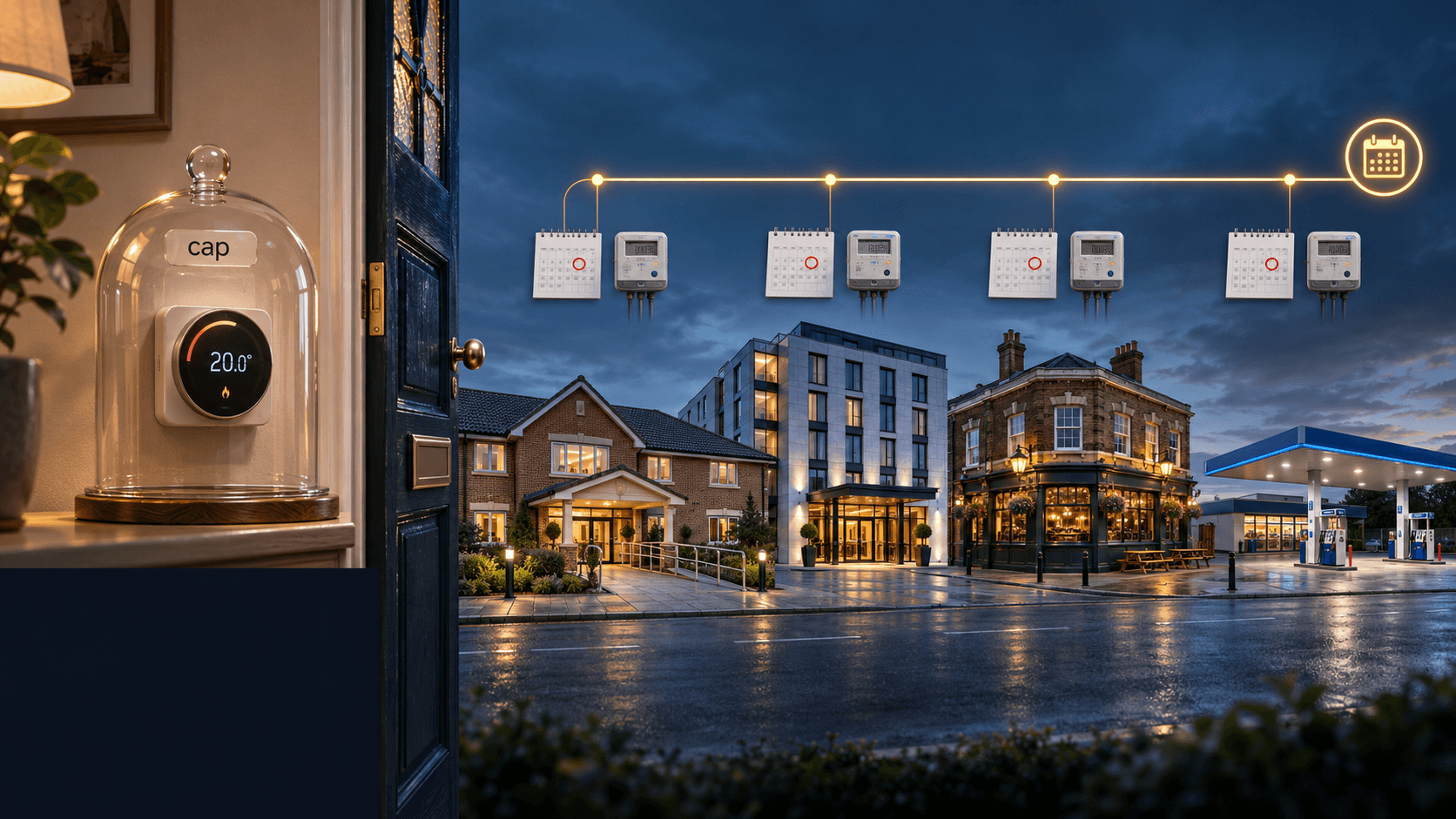
The Price Cap Moves Again, but It Was Never Protecting Your Site
Ofgem's latest price cap announcement is in the headlines. Here's the fact the headlines leave out: the cap protects households. It has never protected your sites.
Every few months the cap becomes the story. Ofgem is clear about who it covers: non-domestic customers, such as businesses and charities, are not protected by it. Your price is whatever your contract says.
That's good news if your contracts are fixed and well timed, and bad news if they're not. Ofgem's own guidance is that businesses on fixed contracts are shielded until the contract ends, but higher wholesale costs may feed through when contracts end or are renegotiated. So the date a contract ends is the date your exposure begins. A site that slips onto out-of-contract rates can face a jump of 40–70%.
Two levers matter far more than the cap. The first is what you pay per unit: align contracts to common dates, tender the estate to the whole market and buy as a group, with 5,000 businesses and multi-millions of buying power behind you. The second is how many units you buy at all. The cap moves the price. Your consumption moves the quantity. Your estate controls the multiplication.
And the right contract isn't the same for every site. A forecourt's flat, 24-hour load, a hotel's morning-and-evening peaks, a pub's evening-and-weekend profile and a care home's round-the-clock demand are different shapes. Buying them all on one default tariff is leaving money on the table.
What AP Prokure Does
● Every energy contract tracked to renewal, so no site silently drifts onto out-of-contract rates.
● Contracts aligned to common terms and co-terminus dates, and bought across the whole market as a group.
● Consumption reviewed alongside price, so you buy the right amount at the right rate — typically 10–15% saved on key renewals, up to 45% across a full estate alignment.
The Cost of Getting It Wrong
● Care homes: an energy contract lapses across several homes in the coldest quarter, a jump that can't be passed on to residents.
● Hotels: a large estate renews site by site, each with its own supplier and date, capturing none of the group's leverage.
● Hospitality: pubs and restaurants on one default tariff, regardless of a load that peaks in the evening and at weekends.
● Forecourts: a flat 24-hour load bought on a standard contract, with no comparison across the whole market.
Don't watch the cap. Watch your end dates and your consumption. When does each of your energy contracts expire — and who is watching?
How Much Can We Save? Find out at savemore.approkure.com.
Follow AP Prokure for the weekly Thursday Fixture, and subscribe to our newsletter.