Blog · The Thursday Fixture
Battery Storage for Care Homes & Hotels | AP Prokure
Care homes & hotels peak after the sun has gone. How battery storage can shave peaks, shift load and support resilience, and how to tell if your site suits one.

Alistair Yates
Published: 19 November 2026 · 2 min read
Dark by Half Past Four: What Battery Storage Does for a Site That Peaks After the Sun Has Gone
By the third week of November the sun is down before half past four. For care homes and hotels, that's exactly when the day's heaviest demand begins.
Think about a care home at five o'clock: evening meal, hot water for evening care, lights on, heating at full. Think about a hotel: check-ins, the restaurant opening, the bar filling, every room heating up. Demand peaks just as solar output disappears, and often just as grid power is most expensive and the network most stretched.
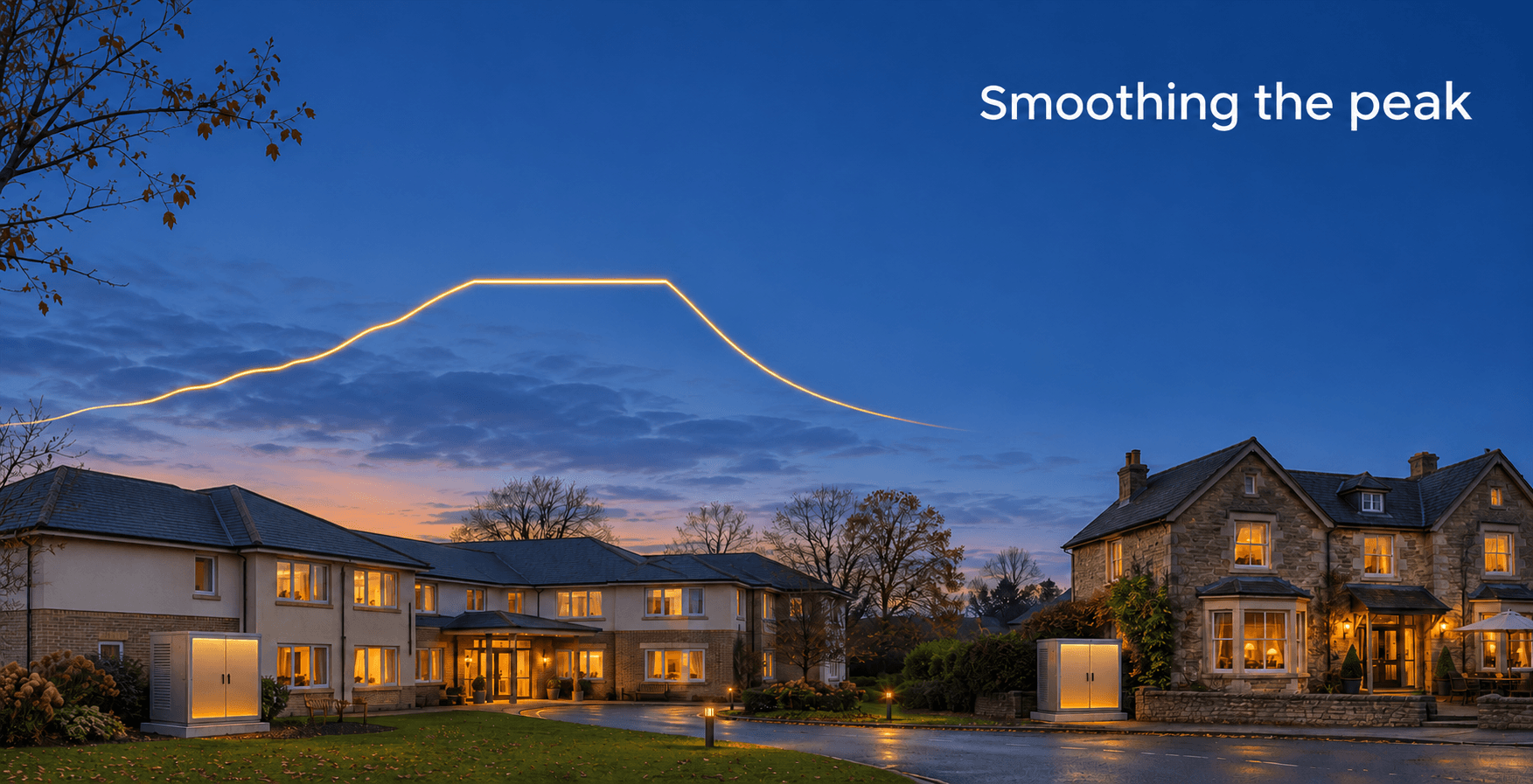
Battery storage addresses that mismatch. It can charge when power is cheaper or when solar is in surplus, and discharge when demand peaks: peak shaving and load shifting. It can store surplus solar rather than exporting it at a low rate. And it can help support critical loads during a grid outage, subject to how the system is designed.
It isn't right for every site. The economics depend on the tariff, how sharp and regular the evening peak is, whether there's solar to pair it with and what the grid connection allows. Installation costs are real. That's why storage should follow the audit, not precede it: you need the half-hourly profile to know whether there's a peak worth shaving.
For care homes there's a second argument. Heating, hot water and nurse call can't be allowed to fail. A battery isn't a substitute for a continuity plan, but it can be part of the resilience picture, provided it's designed, installed and insured properly.
What AP Prokure Does
● Half-hourly demand profiles per site, so peaks worth shaving are identified before any battery is specified.
● Battery storage assessed alongside solar and the energy contract as one system, not three separate quotes.
● Installation, certification and maintenance records held per site, with fire-safety and insurer requirements checked up front.
The Cost of Getting It Wrong
● Care homes: a heavy evening load on peak-rate power, with no resilience plan beyond hoping the grid holds.
● Hotels: a solar proposal that exports at midday while the site buys at full price at 7pm.
● Multi-site: batteries specified for sites with no peak to shave, because nobody looked at the data.
The sun sets by half past four. Does your biggest bill start then — and have you looked at what could change that?
Book a Free Audit — find out what each of your sites consumes, pays and could earn.
Follow AP Prokure for the weekly Thursday Fixture, and subscribe to our newsletter.